


If you’re going to do a thing, and do it well, it’s worth taking it seriously.
Side projects and hobbies can sometimes feel unsatisfying, and lack a sense of fulfillment. Often it’s because, even if it’s only in the back of your mind, you’re not taking it seriously. They’re “just for fun.”
But even fun can be taken seriously. Seriousness doesn’t imply “unfun,” or that we can’t laugh or smile while we do the thing. It doesn’t have to mean putting on a stern face and removing the enjoyment from the work.

To me, seriousness implies intentionality, or a sense of directedness. Like you’re pursuing a particular objective, even if that objective isn’t a long term end state. It may simply mean what you want to accomplish in the next hour.
If I sit down to write an article “unseriously,” I might allow myself to get distracted after 3 minutes and walk away from it. But with intentionality, there’s a sense of “do it anyway” where you’re honoring a promise to yourself, predetermined. That doesn’t have to mean that you know where the piece is going in the end. I don’t have to know it’ll be 3,000 words and make the following 3 points. All I have to do is sit down with the goal of working on it for the next 30 minutes, or hour, or minimum word count. What happens in that window is fungible and allowed to be undefined, yet still taken on with intention.
Consider Steven Pressfield’s framing in his book, Turning Pro:
When we convene day upon day in the same space at the same time, a powerful energy builds up around us. This is the energy of our intention, of our dedication, of our commitment.
Commitment is a great word, directly related to this type of seriousness. People don’t necessarily think of hobbies when they think “take something seriously,” or about commitment to recreational activities. But even a pastime can be executed with commitment. Seriousness and focus reinforce one another.
Seriousness means bringing your attention, intention, and focus to the work, more than anything else. Whether you know the end state with clarity, or chase it with an unsmiling poker-face, bears little on your level of seriousness.
A practice I’ve found useful in cultivating seriousness in my own work is to use habit-forming techniques. Especially for interests and hobbies, or non-critical creative activities, creating a pattern of repeatability for yourself — and an expectation of performance — begins to coax the seriousness out of you over time.
This cultivation also requires patience. It’ll take more than a few reps to get comfortable.
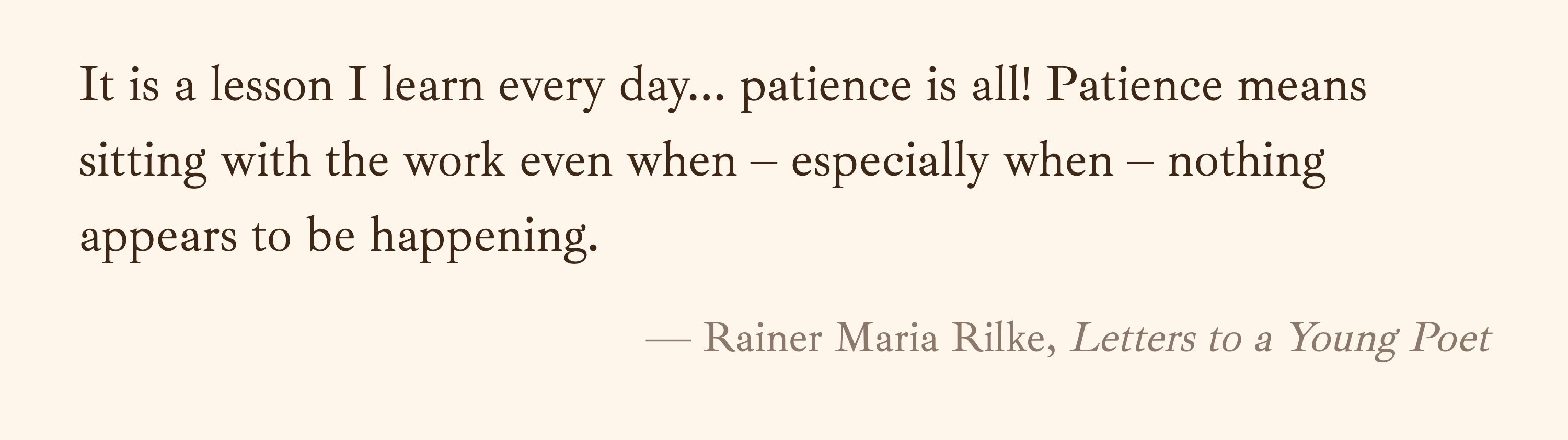
Patience with this process of repetition is in a circular feedback loop with taking work seriously. The more you force yourself into deliberate practice, the more seriousness will grow with your effort. And with seriousness comes more practice, more focus, more outcome.
In thinking about creating these spaces of focus, honing the muscle of seriousness, I always come back to a quote from Jerry Seinfeld on his writing process. Even as a decades-long superstar comedian, he still has a rigorous daily ritual around his writing:
I still have a writing session every day. It’s another thing that organizes your mind. The coffee goes here. The pad goes here. The notes go here. My writing technique is just: You can’t do anything else. You don’t have to write, but you can’t do anything else.
That’s the epitome of taking the work seriously.