


Not long after my son Everett learned to walk, he never wanted to sit in a stroller anymore. As long as he wasn’t over-tired — and especially if we were somewhere new or interesting — he’d climb down and start walking around. I used to take him with me on errands, just him and I. We still do regularly, at age 8 now.
There’s one specific instance like this lodged in my memory.
One evening, not long before his bedtime, he rode with me over to Home Depot to get a few things. We grabbed one of the carts up front, and he naturally wanted to be the one that pulled it out of the row himself. I stuck him in the cart seat (the only kind of kids’ vehicle he’d readily ride in) and we walked inside.
Big box stores and hardware stores have always been his favorite. There’s plenty to touch that you can’t really break, and on some aisles you can even play hide-and-seek in the palettes and boxes. When he was a little older, he always wanted to pick things up and put them in the cart, saying “this is on my list.” I let him do his own shopping and just put the stuff back before we left the aisle. That extra freedom from dad makes this kind of trip more compelling.
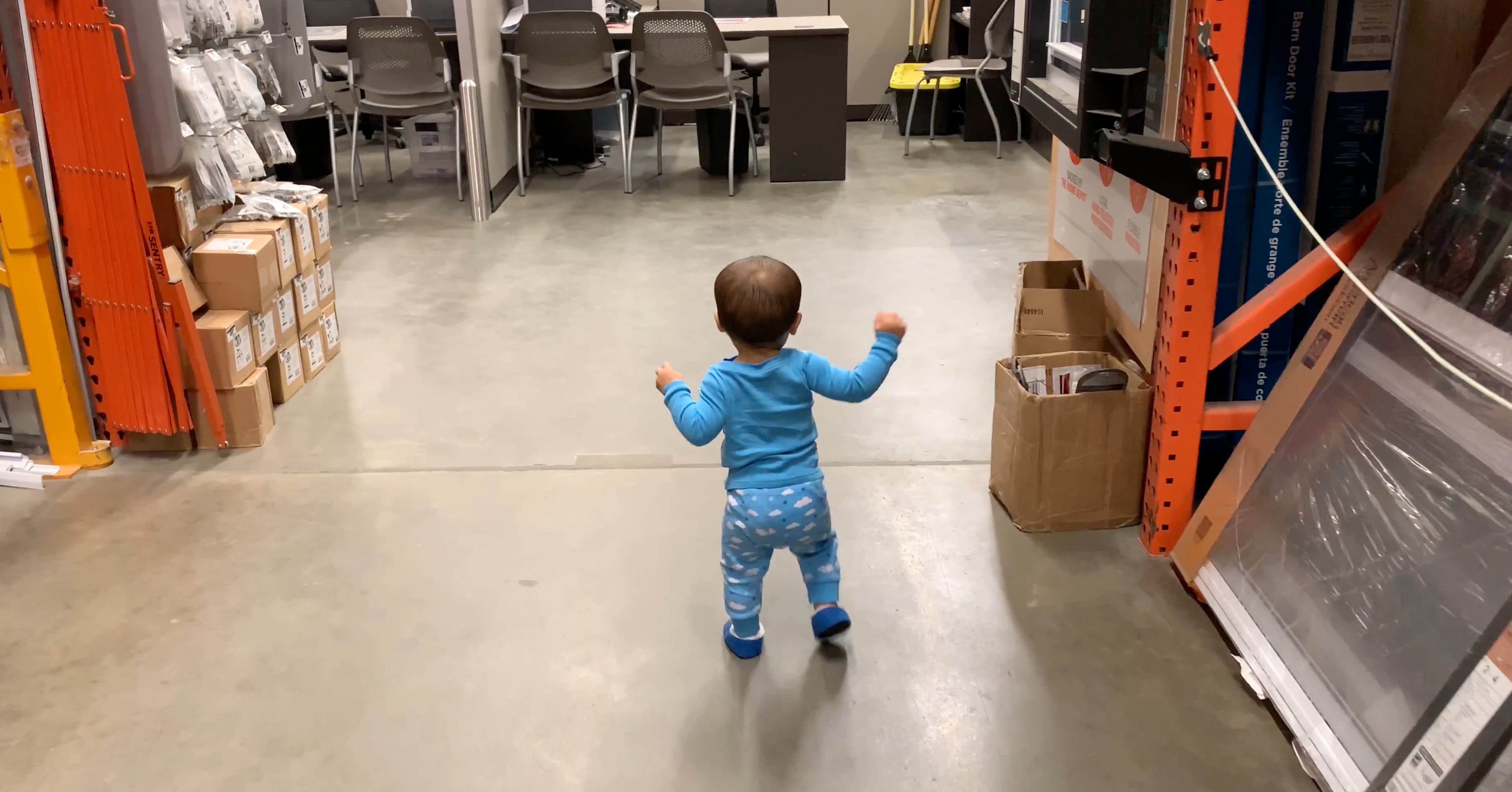
As we’re about 2 aisles into the store, he made a fuss to get out and walk himself. Entirely predictable. The explorers’ bug got him. I lifted him out of the seat, set him down, and off he went. It’s almost like his feet were already moving, like the roadrunner from the cartoons. The second he hit the ground he took off.
As a parent this kind of thing is tiring sometimes. You’re just trying to make a quick trip and get something checked off, and the kids always have other plans. I just do my best to set my expectations accordingly: if the kids are with me, assume a 30-50% longer trip time.
This time instead of trying to get my errands done, I just started following him. To see how far he’d really go and where his exploration would take him. He was scratching his curiosity itch, and I was scratching mine.
He went all the way across the store’s front, greeted by each cashier as he walked all the way down to the building materials. I thought he’d catch me following him as he rounded the corner, but I dodged him.
This continued for a long way. He’d stop periodically and look around or touch something, but he never looked back behind him. Never came looking for me. He just walked and walked (or toddled) his way around, circumnavigating a huge rectangle a couple hundred yards all the way around the store, and back to the entrance where we walked in.
When it looked like he was headed for the exits, I called to him and picked him up, smiling.
I’m don’t consider myself a “free-range” parent, one that goes out of the way to challenge kids with quests or anything. Though I do lean toward that philosophy when it comes to letting our kids “off the leash,” as it were. When I let my son roam a store like this, it’s harmless exploration — not really “unsupervised” or free play with no parents, or something. I’m following him no more than 10 feet behind most of the time. But to him he was just going, no deep thought (best I can tell) about where I was or if he needed me.
If you let kids play and explore, to just figure things out on their own, they’ll get more and more comfortable identifying for themselves what they enjoy, and what they’re curious about.
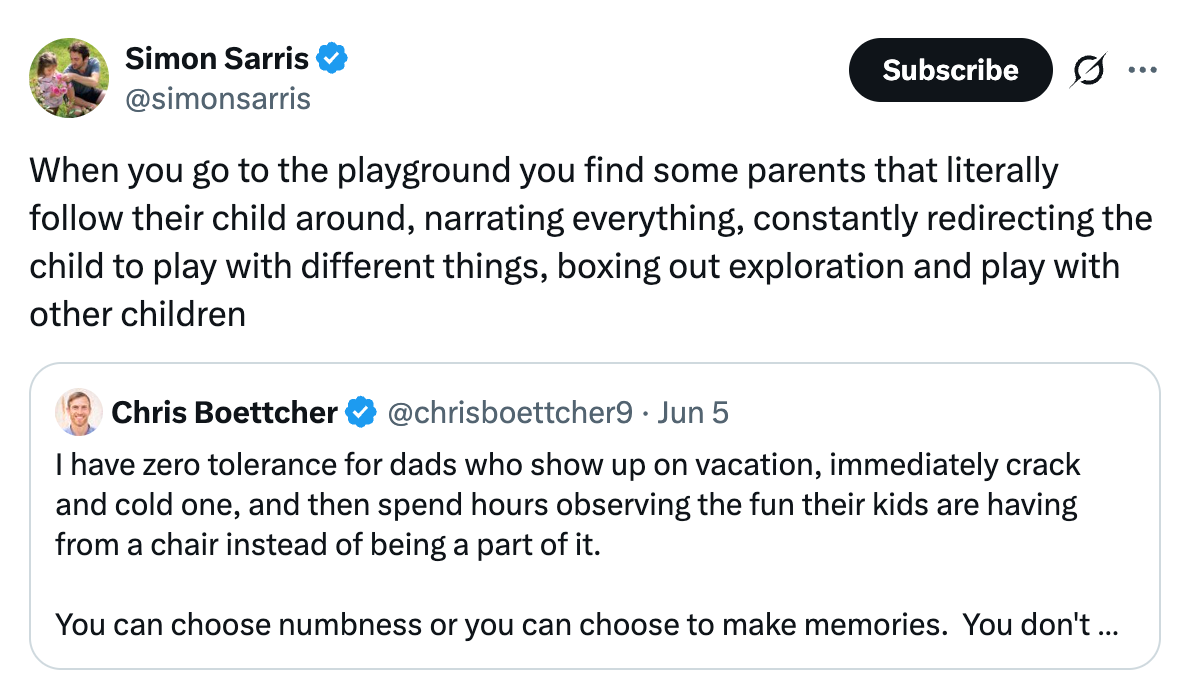
This post from Simon Sarris reminds me of the kind of thing our kids would do regularly at our neighborhood playground if you just sat back and observed. I’d sit on the grass and watch as they, instead of playing on the equipment, collected every single stick and leaf and acorn to assemble a tiny little “campsite,” complete with fire and chairs encircling it, for the squirrels I guess. Sure every now and then I’d walk around with them and point things out, but there’s a balance to everything. Time with them is valuable for both parents and kids, as is the free-zone time for them to wander on their own. It’s detrimental to their curiosity to curate every second of their exploring time, just as it is to vanish on them when they’re interested to show you something.
We should be giving our kids a long leash to explore on their own, with a strong safety net underneath. Your job as a parent is facilitator as much as protector and provider. We’re there to fulfill the basic needs and to insulate against the dangerous or outright catastrophic, but not to control every moment of curious attention. Let them roam, let them explore.